
What Is a Website?
A website is a collection of linked web pages that share one domain name and are published on the internet, so anyone with a browser can open them. Each website is stored on a web server and can hold text, images, videos, forms, and tools. Examples include a news site, an online store, a company page, or a free tools site like WebToolar.
How Does a Website Work?
When you type an address like webtoolar.com into your browser, a chain of steps runs in about a second:
- Your browser (Chrome, Safari, Edge) asks a DNS server which server holds that domain.
- DNS replies with the server’s IP address, a number like 203.0.113.10.
- The browser sends a request to that server, usually over HTTPS (the secure version of HTTP).
- The server sends back the files for the page: HTML for structure, CSS for design, and JavaScript for interactive features.
- The browser reads those files and shows you the finished page.
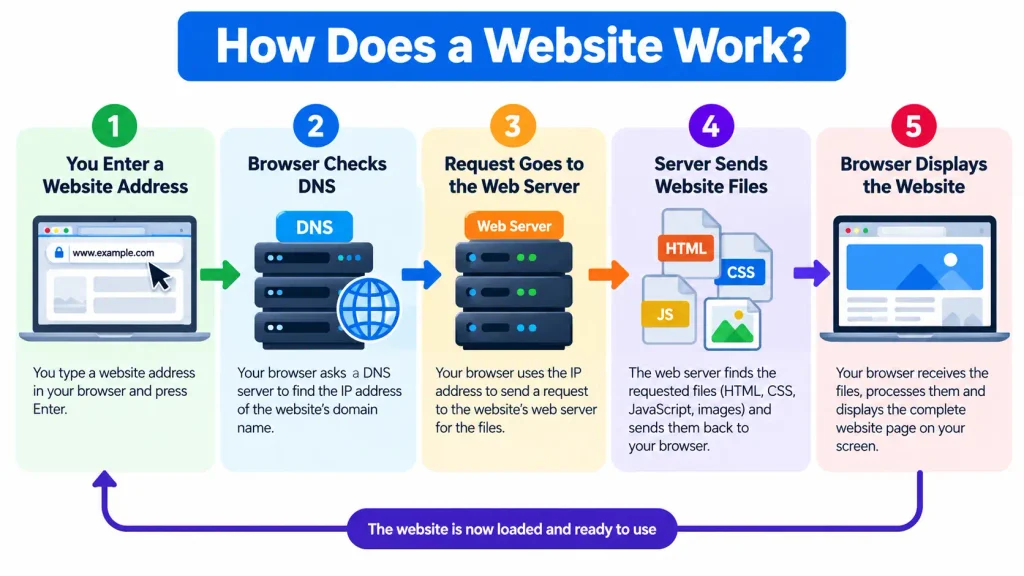
In practice, this is why a site can feel slow. Any weak link, such as a slow server, heavy images, or too many scripts, adds delay.
Websites come in two basic forms:
- Static websites show the same fixed content to every visitor. They are built from plain HTML files.
- Dynamic websites build the page on the server each time, using a database. WordPress, online stores, and most modern sites work this way.
What Are the Main Parts of a Website?
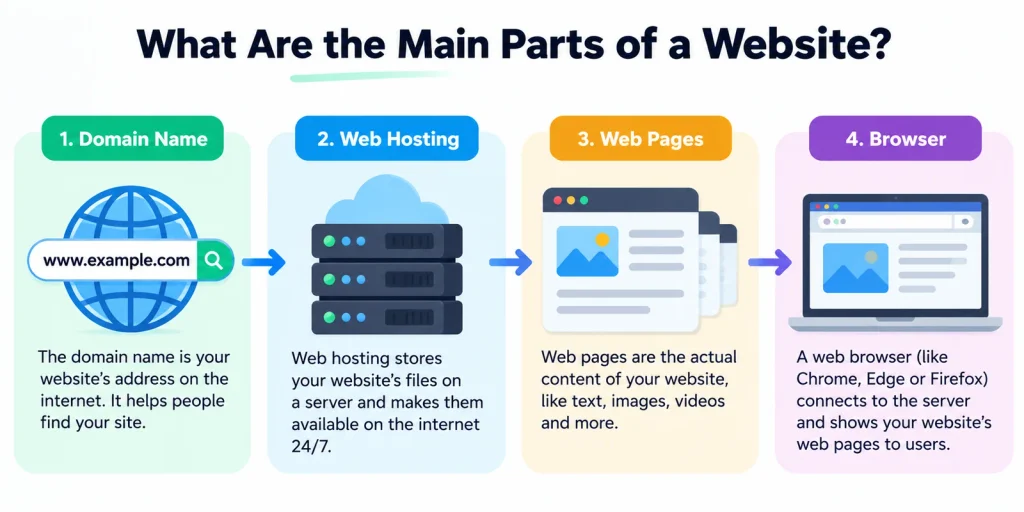
Every website needs four basic things to be live:
- Domain name: the address people type, such as
example.com. A .com domain usually costs around $10 to $1,500 per year, depending on the registrar and available offer. - Web hosting: the server space where your files are stored. Shared hosting plans in India commonly start from a few hundred rupees per month.
- Web pages: the individual documents that make up the site, such as a home page, an about page, and a contact page.
- Browser: the software visitors use to open and read your pages.
Prices change often, so check the current rate with your registrar and host before budgeting.
Most sites also have a navigation menu, a header and footer, and a content management system (CMS) such as WordPress that makes editing easier without writing code.
What Are the Different Types of Websites?
Websites are usually grouped by what they do.
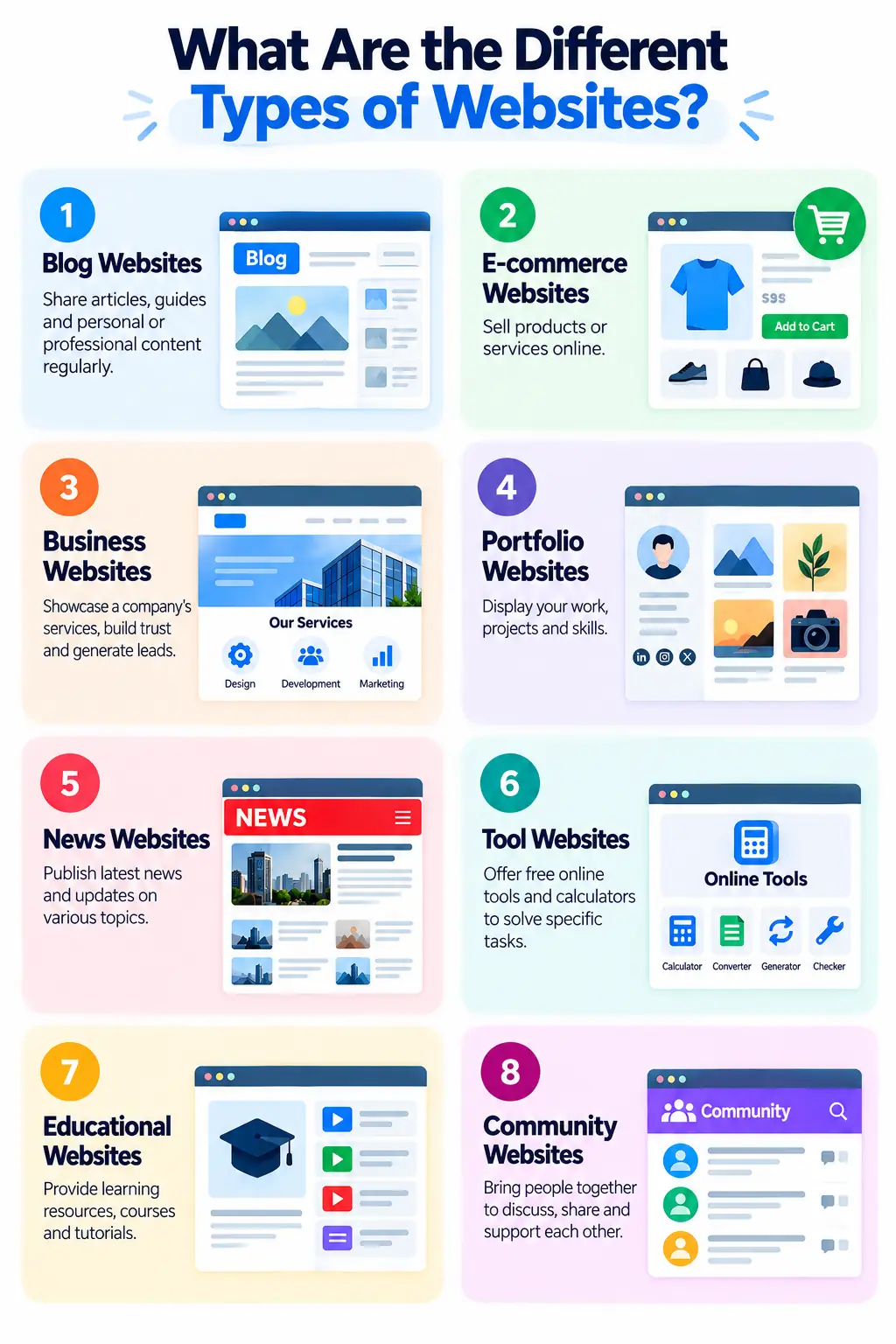
| Type | Main purpose | Example |
|---|---|---|
| Informational or blog | Share articles and knowledge | Inshortpedia, Wikipedia |
| E-commerce | Sell products online | Amazon India, Flipkart |
| Business or portfolio | Show services, build trust, get enquiries | A local clinic or agency site |
| Tool or utility | Let users complete a task in the browser | WebToolar, online calculators |
| News and media | Publish current events | The Hindu, NDTV |
| Social and community | Let users post and interact | Facebook, Reddit |
| Educational | Teach courses or lessons | Khan Academy, Coursera |
| Government | Provide public services and forms | india.gov.in |
Some sites mix types. A wellness brand, for example, can be a business site and an online store at the same time.
What Is the Difference Between a Website and a Webpage?
A webpage is a single document, like one article or one product page. A website is the full set of pages connected under one domain. Think of a website as a book and a webpage as one page inside it.
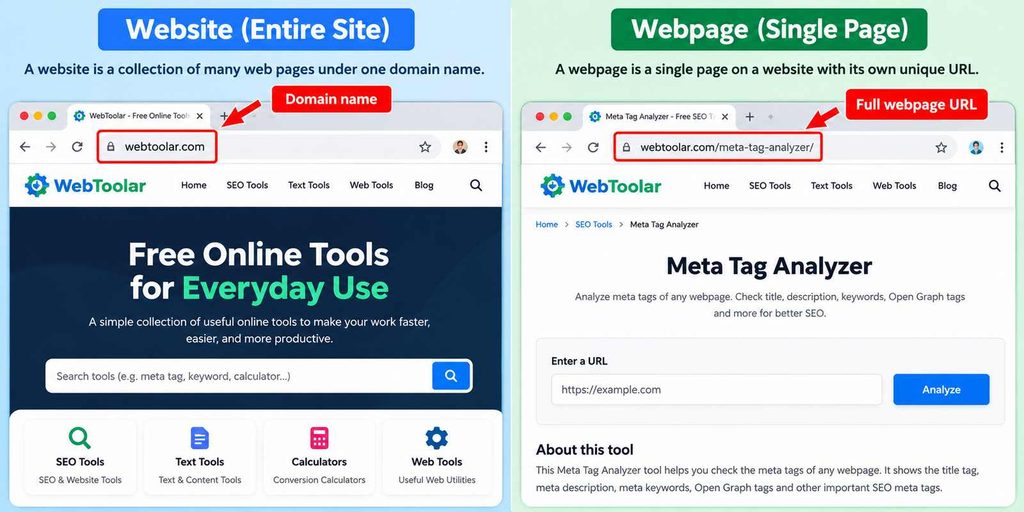
| Feature | Website | Webpage |
|---|---|---|
| What it is | A collection of linked pages | One single page |
| Address | One domain, like example.com | One URL, like example.com/about |
| Purpose | Covers a whole brand, topic, or service | Covers one topic or action |
| Example | webtoolar.com | A single tool page on webtoolar.com |
People often use the two words as if they mean the same thing. In casual talk that is fine, but for SEO the difference matters. Google ranks individual webpages, not whole websites, so each page needs its own clear topic.
Examples of Websites Across Different Industries
Here are real examples for each common type:
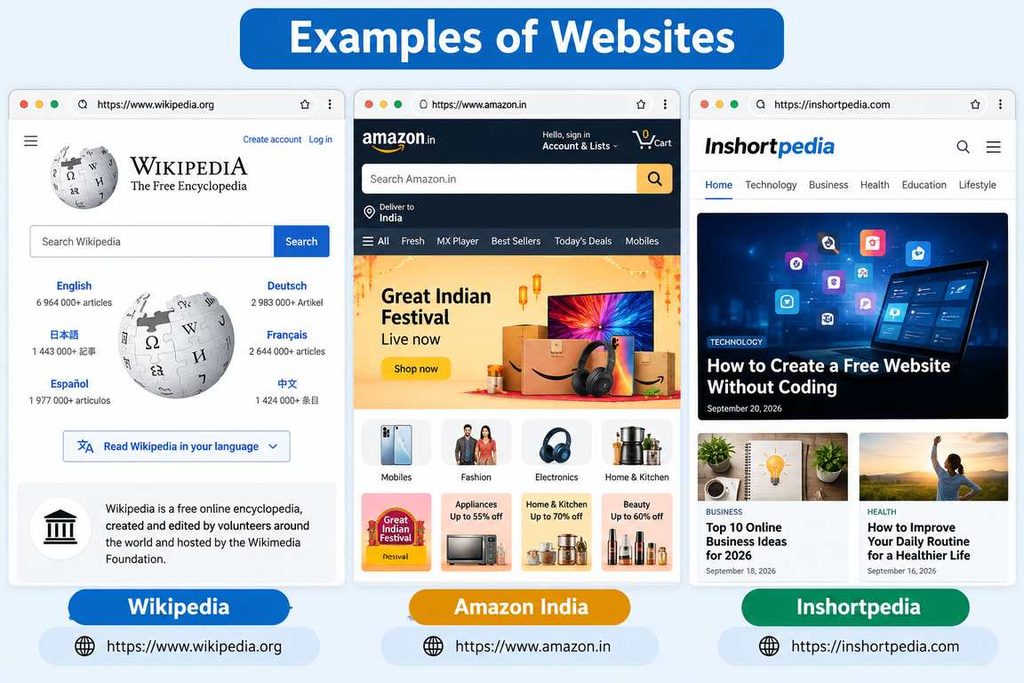
- Wikipedia is an informational website with millions of articles.
- Amazon is an e-commerce website where you can compare and buy products in $.
- Google is a search engine website that shows results from across the web.
- YouTube is a video website where users upload and watch content.
- WebToolr is a tools website where each page is one free online tool, such as Developer tools and SEO tools, Text tools, Calculator tools and many more .
- Inshortpedia is a content website that publishes articles on business, finance, and general knowledge.
A useful fact for scale: the first website was created by Tim Berners-Lee at CERN in 1991, and it was a simple page explaining the World Wide Web project. Today there are over a billion registered websites, but only a small share are active. Sources such as Netcraft and Internet Live Stats publish updated counts, so quote the current figure from them if you use it.
Websites FAQ
What is a website in simple words?
A website is a group of connected pages on the internet that you open using a web address. It can be for reading, shopping, learning, or using a tool. All pages share the same domain name.
What is the difference between a website and a web application?
A website mainly shows information, while a web application lets you perform tasks and save data, like online banking or Google Docs. The line is blurry, because many websites now include app features. A simple test is whether you mostly read or mostly do.
What do you need to make a website?
You need a domain name, web hosting, and content. Most beginners use a CMS like WordPress so they can build pages without coding. You can also use a website builder if you want a faster start.
Is a website the same as the internet?
No. The internet is the global network of connected computers. A website is one type of service that runs on that network, along with email, apps, and file sharing.
How much does it cost to build a website in India?
A basic site can cost roughly $50 to $200 per year for a domain and shared hosting. Custom designed or e-commerce sites cost much more, depending on features and who builds them.